
Most plastic welding requirements can be met with a standard machine, a single ultrasonic press, spin welder or vibration unit, sized and specified for the job. But once a component needs multiple welds performed in one cycle, needs to be integrated into a wider automated assembly line, or involves a production sequence that a standard off-the-shelf machine simply was not designed around, the conversation shifts from choosing a machine to designing one. This is the territory of special purpose machines, and it is a service offering that gets far less attention than the welding technologies themselves, despite solving problems that standard equipment cannot.
What Makes a Machine 'Special Purpose'
A special purpose machine is built around a specific component, process sequence or production line rather than adapted from a standard catalogue design. That might mean multiple welding heads operating in a single cycle, non-standard tooling and fixturing designed around a particular part geometry, or a control system built to integrate with a customer's existing production line rather than run as a standalone unit. The starting point is always the same: understanding the component, the required cycle time, and how the finished machine needs to fit into the surrounding production process, before any equipment is specified.
Real Configurations in Practice
The value of a custom-engineered approach is easiest to see in the range of configurations it makes possible. Recent examples include:
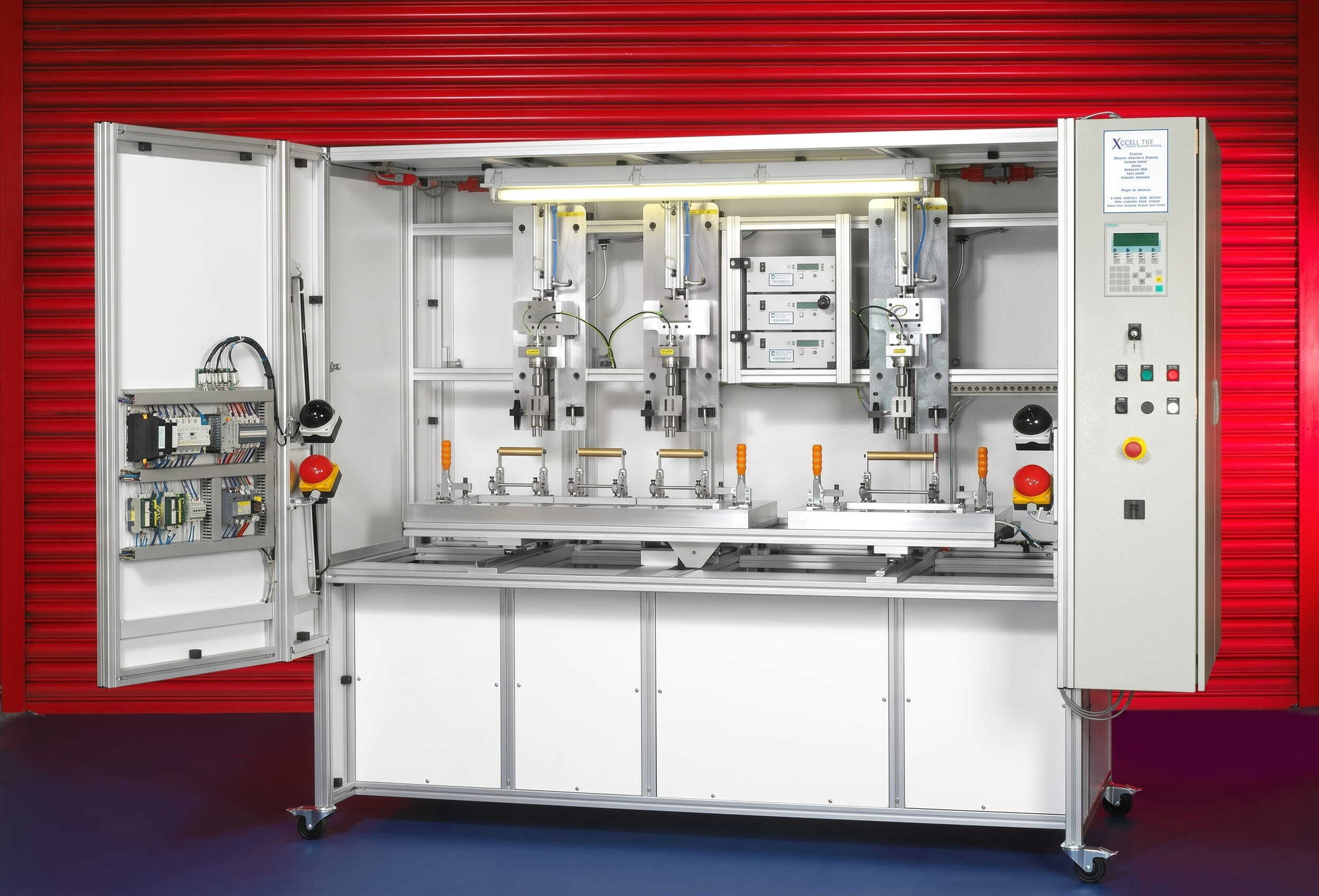
- A six-head 35kHz ultrasonic staking machine for attaching a door pull to a rear door panel in an automotive application, performing six welds in a single cycle rather than requiring six separate operations.
- A three-head 40kHz ultrasonic staking machine for attaching a label badge to an internal trim panel, and a separate three-head 40kHz machine for assembling an under-seat tray, both automotive applications where multi-head tooling significantly reduces cycle time against single-head equipment.
- A servo spin welding machine with a sliding table, built for an automotive application requiring precise, repeatable load and unload positioning as part of a wider assembly sequence.
- A two-head 20kHz ultrasonic welding machine for a medical application, where the first head welds a filter membrane into a moulded part and the second welds the two halves of the filter body together, combining two distinct joining operations into a single integrated machine.
What these configurations share is that none of them would be well served by a standard single-head, single-process machine. Each was built around the specific sequence of operations the component and production line actually required.
Integration With Your Own Automation
Special purpose machines do not have to run as standalone islands of automation. Xfurth's equipment can be supplied for integration into a wider automated assembly line or into a customer's own machine build, with control handled either through a supplied system or integrated into the customer's existing control architecture. CAD data is available for standard equipment configurations, allowing a system integrator or machine builder to assess compatibility early in the design process. Where a customer is working with their own machine builder rather than commissioning a complete system from Xfurth directly, Xfurth's engineering background means the welding equipment itself, whether ultrasonic or spin welding, can be specified and supported as one component of that larger build, with direct input on how it integrates rather than being treated as an unfamiliar black box.
When to Consider a Special Purpose Machine
- A component requires multiple welds, or multiple different joining operations, completed within a single production cycle.F
- Standard tooling and fixturing cannot accommodate the part's geometry or handling requirements.
- The welding operation needs to be integrated into an existing or planned automated production line rather than run as a manual, standalone step.
- Cycle time targets cannot realistically be met by running standard equipment through multiple sequential operations.
Why Early Engagement Matters
Because a special purpose machine is designed around a specific component and process, the earlier a welding specialist is involved in the design phase, the more scope there is to influence part and joint design for a better outcome. Flange geometry, wall thickness and fixture access all affect what is achievable, and decisions made before tooling is committed are far easier and cheaper to change than those made afterwards. This is true of any welding project, but it matters more for special purpose machines, where the equipment itself, not just the tooling, is being built around the part.
Conclusion
Special purpose machines exist for the applications standard equipment cannot serve well: multi-operation cycles, complex integration requirements, and components that do not fit neatly into an off-the-shelf machine's envelope. For design and production engineers working on automated assembly lines, understanding this as a genuine engineering discipline, rather than an expensive last resort, opens up options that a catalogue machine search will not surface.
Xfurth designs and builds special purpose welding machines around your specific component and production requirements, and can integrate ultrasonic or spin welding equipment into your own machine build or automated line.
If a standard machine is not meeting your cycle time, multi-operation or integration requirements, contact Xfurth today to discuss a custom-engineered solution.