

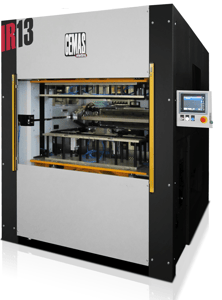
When specifying joining methods for circular thermoplastic components, design engineers frequently face a choice between spin welding and hot plate welding. Whilst both technologies create strong, reliable bonds, they differ significantly in their operational characteristics, cost structures, and efficiency profiles. Understanding these differences enables informed decision-making that optimises both product performance and manufacturing economics.

Process Fundamentals
Before examining cost and efficiency metrics, it's essential to understand how each process operates, as these fundamental differences drive their respective advantages and limitations.
Spin Welding Mechanics
Spin welding joins circular components through rotational friction. One part rotates at high speed whilst pressed against a stationary mating component. The friction generates localised heat at the interface, melting the thermoplastic material. When rotation stops, the molten material solidifies under maintained pressure, creating a permanent bond. The entire cycle typically completes within seconds.
The process requires components with circular or near-circular geometries. Eccentricity variations must remain within tight tolerances to ensure uniform heating around the entire joint circumference. This geometric constraint limits spin welding to specific part configurations but provides significant advantages for components that meet these criteria.
Hot Plate Welding Mechanics
Hot plate welding (also known as heated tool welding) operates through direct thermal conduction. Components are pressed against a heated platen maintained at temperatures above the material's melting point. After sufficient heat transfer creates molten layers on both surfaces, the platen retracts, and the components join under controlled pressure. Typical cycle times are considerably longer than spin welding, ranging from seconds to over a minute depending on material type and part geometry.
Unlike spin welding, hot plate welding accommodates virtually any joint configuration – circular, rectangular, irregular, or complex three-dimensional contours. This geometric flexibility makes it suitable for a broader range of applications, though this versatility comes with trade-offs in other areas.
Capital Equipment Considerations
Spin Welding Equipment Investment
Spin welding machines generally represent a lower initial capital investment compared to hot plate welding systems of equivalent capacity. The relatively simple mechanical design – essentially a high-speed spindle with pressure control – contributes to these moderate equipment costs.
Fixtures and tooling requirements are straightforward, typically comprising a spindle chuck for the rotating component and a nest or mandrel for the stationary part. Custom fixturing is generally less complex and more economical than that required for hot plate welding applications.
Hot Plate Welding Equipment Investment
Hot plate welding systems carry higher initial costs due to their more complex construction. The heated platen itself represents a significant cost component, particularly for large parts or those requiring precisely controlled temperature zones. Custom platen tooling can be substantially more expensive depending on size and complexity.
Additionally, hot plate systems require more sophisticated fixturing to maintain part alignment during the heating, changeover, and welding phases. This adds to the overall tooling investment per part configuration, though the versatility of accommodating complex geometries may justify these costs for applications that cannot use spin welding.
Energy Consumption
Spin Welding Energy Profile
Spin welding demonstrates excellent energy efficiency, as heat generation occurs only during the brief friction phase. The process converts mechanical energy directly into thermal energy at the weld interface with minimal losses to surrounding material or equipment structures.
The spindle motor draws power only during the active welding phase, with minimal standby consumption between cycles. The absence of continuous heating elements eliminates the thermal mass effects that increase energy consumption in other welding methods. Machines reach operating readiness immediately upon power-up, requiring no warm-up period. This characteristic provides additional efficiency advantages in operations with intermittent production schedules.
Hot Plate Welding Energy Profile
Hot plate welding consumes significantly more energy due to the continuous power required to maintain platen temperature. The heated platen must remain at operating temperature throughout production, consuming power even between welding cycles. This continuous energy draw represents a substantial portion of operating costs, particularly for operations with lower production volumes or intermittent schedules.
Warm-up periods before production begins add further energy consumption without producing parts. For operations running multiple short production runs, this overhead becomes particularly significant. However, for continuous high-volume production, the warm-up energy amortises across many parts, reducing its relative impact.
Industry assessments have demonstrated that ultrasonic and friction-based welding methods, including spin welding, can consume substantially less energy compared to heated tool methods – in some cases a fraction of the energy requirement.
Cycle Time and Throughput
Spin Welding Cycle Characteristics
The rapid cycle time of spin welding enables high production rates. A typical cycle comprises part loading, the welding phase (friction and rotation), cooling under pressure, and part ejection – all completed in a matter of seconds.
The instantaneous readiness of spin welding equipment eliminates downtime between production runs. Changeovers for different part numbers require only fixture changes, typically completed within minutes rather than requiring extended setup periods.
Hot Plate Welding Cycle Characteristics
Hot plate welding cycles extend considerably longer due to the sequential heating and cooling phases. The process includes part loading, a heating phase that varies with material type and thickness, changeover when the platen retracts, the joining phase, cooling under pressure, and finally part ejection.
These extended cycle times result in lower throughput per machine. However, hot plate welding compensates through its ability to join multiple components simultaneously using multi-station or continuous-motion systems. Such configurations can achieve comparable throughput to spin welding but require substantially higher capital investment.
The continuous operation of heated platens means production can commence immediately after part changeover, without warm-up delays. However, platen temperature adjustments for different materials may require stabilisation periods.
Operating Cost Considerations
Consumables and Maintenance
Spin welding incurs minimal consumable costs. The primary wear items are spindle bearings and drive components, which have relatively long service lives under normal production conditions. Maintenance requirements are straightforward and infrequent, contributing to lower ongoing operational costs.
Hot plate welding involves higher consumable expenses. Platen surfaces require periodic replacement or refurbishment depending on production volume and materials welded. Heating elements have finite lifespans and need replacement. PTFE platen coatings, where used, require periodic renewal. These consumable costs accumulate over time and should be factored into total cost of ownership calculations.
Labour Requirements
Both processes support similar levels of automation, though the faster cycle time of spin welding can justify automation at lower production volumes. Manual operation labour requirements are comparable on a per-cycle basis, but the higher throughput of spin welding reduces labour cost per part produced.
Floor Space and Facilities
Spin welding machines typically occupy less floor space than comparable hot plate welding systems. The absence of heating elements eliminates requirements for enhanced ventilation or temperature control that hot plate welding may necessitate in certain environments, potentially reducing facilities costs.
Material and Joint Design Considerations
Spin Welding Material Performance
Spin welding performs exceptionally well with most thermoplastics, including challenging semi-crystalline materials like polypropylene and polyethylene. The high-speed friction generates sufficient heat to overcome the narrow melting range characteristic of these materials. Glass-filled compounds also weld effectively, though filler content should be considered in joint design.
Joint design remains relatively simple, typically employing butt joints with or without tongue-and-groove features. The uniform circumferential heating eliminates the need for energy directors or complex joint geometries, simplifying mould design and reducing tooling costs.
Hot Plate Welding Material Performance
Hot plate welding accommodates virtually any thermoplastic, including materials difficult to weld by other methods. The controlled, uniform heating suits applications requiring precise temperature management. Very large parts or those with thick walls benefit from hot plate welding's prolonged heating phase, which ensures complete material melt-through.
Complex joint geometries including step joints, lap joints, and combinations are readily achieved. The method handles dissimilar materials particularly well when their melting temperatures are reasonably compatible, expanding design possibilities beyond what spin welding can accommodate.
Production Volume Considerations
The economic crossover point between these technologies depends heavily on production volume. Spin welding's lower capital costs and faster cycle times make it economically attractive even for relatively modest production volumes when part geometry allows. The rapid return on investment through lower per-part costs and reduced energy consumption strengthens the business case for circular components.
Hot plate welding becomes more economically viable at higher production volumes where multi-station systems can be justified, or where the part geometry simply precludes spin welding. For low-volume production or prototype work, the higher capital and operating costs may be difficult to justify unless no alternative joining method is suitable.
Application Suitability Summary
Optimal Spin Welding Applications:
- Circular or cylindrical components (tubes, filters, bottles, containers)
- High-volume production requiring rapid cycle times
- Applications prioritising energy efficiency
- Semi-crystalline materials requiring quick thermal cycles
- Operations with limited floor space or capital budget
- Parts requiring minimal thermal exposure
Optimal Hot Plate Welding Applications:
- Non-circular or complex geometries
- Large components or thick-walled parts
- Dissimilar material combinations
- Applications requiring multi-station simultaneous welding
- Production volumes where cycle time is less critical
- Parts benefiting from extended thermal conditioning
Long-Term Economic Considerations
When evaluating the economic merits of each technology, total cost of ownership over a typical equipment lifecycle reveals distinct profiles. Spin welding typically offers advantages in:
- Lower initial capital investment
- Reduced energy consumption
- Lower maintenance and consumable costs
- Faster return on investment through higher throughput
Hot plate welding may prove more economical when:
- Part geometry precludes spin welding
- Multiple components can be welded simultaneously
- Material combinations specifically require hot plate characteristics
- Existing equipment can be repurposed or expanded
For many applications involving circular components, spin welding delivers superior cost-effectiveness across the equipment lifecycle. The combination of lower capital costs, reduced energy consumption, minimal consumables, and higher throughput creates a compelling economic case that strengthens as production volumes increase.
Conclusion
For design engineers specifying joining methods for circular thermoplastic components, spin welding offers compelling advantages in capital cost, energy efficiency, cycle time, and operating expenses. Its rapid processing and lower energy requirements translate directly into reduced cost per part and decreased environmental impact.
Hot plate welding maintains its position as the versatile solution for non-circular geometries, large parts, and applications requiring its specific thermal characteristics. The higher costs reflect greater capability and geometric flexibility rather than inferior technology.
At Xfurth, our extensive experience with both technologies enables us to provide objective guidance matching process capabilities to application requirements. The decision ultimately rests on part geometry, production volume, material selection, and quality requirements. We encourage design engineers to consult with our technical team to evaluate which technology best serves their specific application, ensuring optimal balance between performance requirements and economic considerations