
Ultrasonic welding is only as reliable as the tooling that delivers energy to the joint. While much attention is rightly given to machine settings and material selection, it is the sonotrode, booster, and associated stack components that translate electrical energy into precisely controlled mechanical vibration at the weld interface.
For design engineers specifying new assemblies or troubleshooting existing processes, a sound understanding of tooling design and function is essential. This article explains how ultrasonic tooling works, how the main components interact, and what engineers need to consider when selecting or commissioning tooling for their application.

The Ultrasonic Stack: An Overview
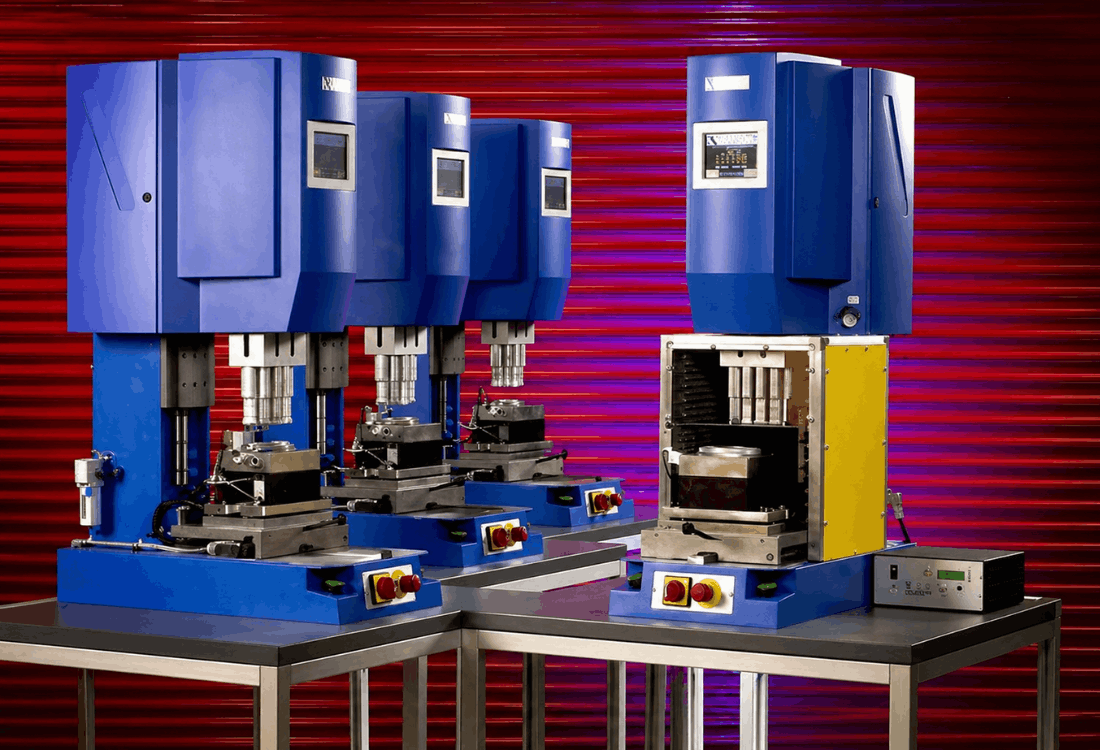
The ultrasonic stack is the assembly of components that generates and delivers mechanical vibration to the workpiece. It consists of three primary elements: the transducer (or converter), the booster, and the sonotrode (also called the horn). Together, these components must be acoustically tuned to resonate at the operating frequency of the welding system, typically 20 kHz, 30 kHz, or 40 kHz.
Each component in the stack serves a distinct function:
- The transducer converts high-frequency electrical energy from the generator into mechanical vibration using piezoelectric ceramic crystals.
- The booster amplifies or attenuates the amplitude of vibration produced by the transducer, and provides a mounting point for the stack within the press.
- The sonotrode transmits vibration directly to the plastic parts, focusing energy at the weld joint.
The entire stack must be designed as an integrated acoustic system. Mismatches in material, geometry, or resonant frequency between components will compromise energy transfer and weld consistency.
The Sonotrode (Horn): Function and Design
The sonotrode is the component in direct contact with the workpiece. It is the most application-specific element of the stack, typically custom-designed to match the geometry of the part being welded. Sonotrodes are manufactured from titanium alloy, aluminium alloy, or tool steel, each offering a different balance of acoustic performance, wear resistance, and weight.
Titanium is the most widely used material for demanding applications. It offers excellent acoustic properties, high fatigue resistance, and a long service life even at high amplitudes. Aluminium sonotrodes are lighter and easier to machine, making them well-suited for large-area tools and lower-intensity applications. Steel is used where abrasion resistance is critical, though its acoustic performance is inferior to titanium.
Acoustic Tuning
For a sonotrode to function correctly, it must resonate at the generator's operating frequency. This requires the sonotrode length to correspond to a half-wavelength of sound at that frequency in the chosen material. The speed of sound varies significantly between materials, which means the physical length of a titanium sonotrode will differ from an aluminium one tuned to the same frequency.
Finite element analysis (FEA) is used during design to simulate vibrational behaviour, identify unwanted resonance modes, and optimise geometry before manufacture. A tuning allowance is typically machined into the sonotrode, allowing fine adjustment during the qualification process.
Face Geometry and Surface Treatment
The contact face of the sonotrode must match the profile of the part to ensure uniform energy distribution across the weld joint. Common configurations include flat faces for simple geometries, contoured faces for curved or complex parts, and multi-point designs for assemblies requiring energy concentration at specific locations.
Where the sonotrode contacts a cosmetically sensitive surface, textured or coated faces can be used to minimise marking. In applications involving abrasive or reinforced plastics, hard-wearing surface treatments or carbide-tipped faces extend tool life.
The Booster: Amplitude Control
The booster connects the transducer to the sonotrode and performs two functions: it provides a nodal mounting point for the stack in the press, and it modifies the amplitude of vibration passed through the system. Boosters are characterised by their gain ratio, which is the ratio of output amplitude to input amplitude.
A booster with a gain ratio greater than 1:1 amplifies amplitude, delivering more vibration energy to the sonotrode face. A ratio below 1:1 reduces amplitude, which may be necessary for delicate materials or sensitive applications. Gain ratios typically range from 0.4:1 to 2.5:1.
Selecting the correct booster gain is an important process optimisation step. Too little amplitude produces incomplete fusion and weak welds; too much generates excessive heat, material degradation, or cosmetic damage. The booster gain, combined with sonotrode geometry, determines the final amplitude at the weld interface.
Frequency Selection: 20 kHz, 30 kHz, and 40 kHz
Ultrasonic welding systems are available at different operating frequencies, and the choice of frequency affects both tooling design and application suitability.
- 20 kHz systems deliver high power and amplitude, making them the standard choice for most structural welding applications in automotive, medical, and industrial sectors. Tooling tends to be larger and more robust.
- 30 kHz systems offer a balance between power and precision, suitable for medium-sized components requiring controlled energy input.
- 40 kHz systems produce lower amplitude and are used for delicate components, small assemblies, and thin-walled parts where excessive energy would cause damage.
Xfurth manufactures ultrasonic tooling across a wide range of frequencies, with each sonotrode precisely engineered for its target application and machine system.
Near-Field and Far-Field Welding
The relationship between the sonotrode and the weld joint has a direct bearing on process efficiency. In near-field welding, the sonotrode contacts the part within 6 mm of the weld joint. Energy transfer is direct and efficient, and this configuration is preferred for semi-crystalline plastics, thin walls, and applications requiring precise energy control.
In far-field welding, the sonotrode contacts the part more than 6 mm from the joint. Energy must travel through the body of the plastic to reach the weld interface, which introduces attenuation and inconsistency. This approach is generally limited to amorphous plastics with good vibration transmission properties.
Joint design and tooling design must be developed in tandem. The position of the energy director, shear joint, or step joint relative to the sonotrode contact point determines whether near-field or far-field conditions apply.
Tooling Maintenance and Service Life
Sonotrodes are precision acoustic instruments and require appropriate care to maintain performance. Fatigue cracking, wear at the contact face, and changes in resonant frequency due to surface damage can all degrade weld quality over time. Regular inspection, re-tuning, and preventive maintenance are important aspects of process quality management.
Key maintenance considerations include:
- Monitoring weld quality metrics for drift that may indicate tooling wear
- Inspecting the sonotrode face for signs of cracking, erosion, or marking
- Re-tuning or reconditioning sonotrodes when frequency deviation is detected
- Maintaining correct torque on booster-to-sonotrode connections to prevent acoustic losses
Xfurth provides full tooling support, including design, manufacture, reconditioning, and replacement across all major machine platforms. Our in-house engineering team can advise on tooling specification for new applications or supply replacement tooling for existing systems, including legacy Herfurth equipment.
Commissioning New Tooling
When introducing new tooling into production, a structured qualification process ensures performance and consistency. This typically involves:
- Verifying the resonant frequency of the assembled stack on a horn analyser
- Conducting weld trials with representative parts and materials
- Establishing optimum amplitude, pressure, and weld mode parameters
- Validating weld strength through mechanical testing appropriate to the application
- Documenting all process parameters for production control
Close collaboration between tooling engineers and process engineers during commissioning is the most reliable route to a stable, repeatable welding process.
Conclusion
Ultrasonic welding tooling is far more than a contact point between machine and part. The sonotrode, booster, and transducer form an integrated acoustic system whose design determines the efficiency, consistency, and quality of the welding process. Understanding how these components work, how they interact, and how to maintain them is essential for any manufacturer seeking to get the best from their ultrasonic welding investment.
To discuss tooling requirements for a new or existing application, contact the Xfurth team at www.xfurth.com/contact-us or call +44 (0)1582 436000. We design and manufacture ultrasonic tooling across a wide range of frequencies and can support all makes of machine.